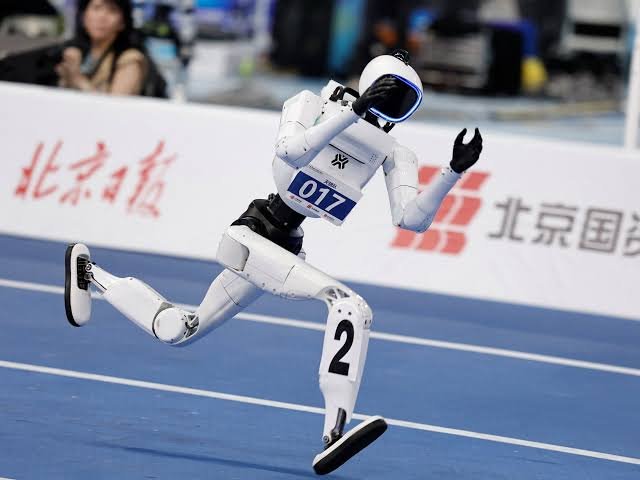
BEIJING, Aug. 28 — China’s Tiangong Ultra humanoid robot has recorded a faster 100-metre time than Usain Bolt’s long-standing human world record, highlighting advances in robotic mobility while also underscoring the differences between machines and human athletes.
Tiangong Ultra completed its fastest 100-metre run in 8.64 seconds this week at the 2026 World Humanoid Robot Games in Beijing, compared with Bolt’s 9.58-second world record set in Berlin in 2009. The robot’s average speed was about 42 kph (26 mph).
Sports science and robotics experts said, however, that the comparison is not straightforward because the robot and human sprinter use fundamentally different mechanisms to generate speed.
Bolt began his record-setting race with a reaction time of 0.146 seconds and used starting blocks to generate horizontal force and accelerate rapidly. Tiangong starts from an upright position and, during one of its record runs, took almost a second to begin moving after apparently failing to register the starting signal.
Iain Hunter, a professor of exercise science at Brigham Young University and a sports scientist with USA Track and Field, said the robot could potentially become faster if it adopted a starting-block technique. He estimated that Bolt would have reached the five-metre mark significantly earlier than Tiangong.
The robot’s advantages become more apparent once it is underway. Its developers have redesigned parts of its torso and waist to reduce weight and the energy required to move its body. They have also upgraded its motors, range of motion and control software.
Rather than replicating a human sprinter’s stride, Tiangong appears to use a shorter and faster cadence. A Reuters review of race footage found that the robot took more than 50 steps during one record-setting run, compared with 41 steps for Bolt.
Robotics experts said the gait appears to be shaped largely by the capabilities of the robot’s motors and the need to maintain balance. Shorter steps can allow a humanoid robot to increase speed while reducing the risk of falling.
Another major difference is fatigue. Human sprinters rely on muscles, tendons and flexible joints to generate and absorb force, and neuromuscular fatigue can cause their speed to decline toward the end of a race.
Electric motors and gear systems are not constrained by fatigue in the same way. Tiangong maintained a high speed through the final stage of its run before eventually crashing into a padded barrier at the end of the track.
That limitation highlights a broader challenge for humanoid robotics: speed alone does not necessarily demonstrate athletic or practical superiority.
Experts said future advances will likely depend not only on faster movement but also on a robot’s ability to stop, change direction, maintain balance and make independent decisions in real time.
For humanoid robots, the next benchmark may therefore be less about how quickly they can run in a straight line and more about how effectively they can navigate unpredictable environments without human intervention.
About the Author