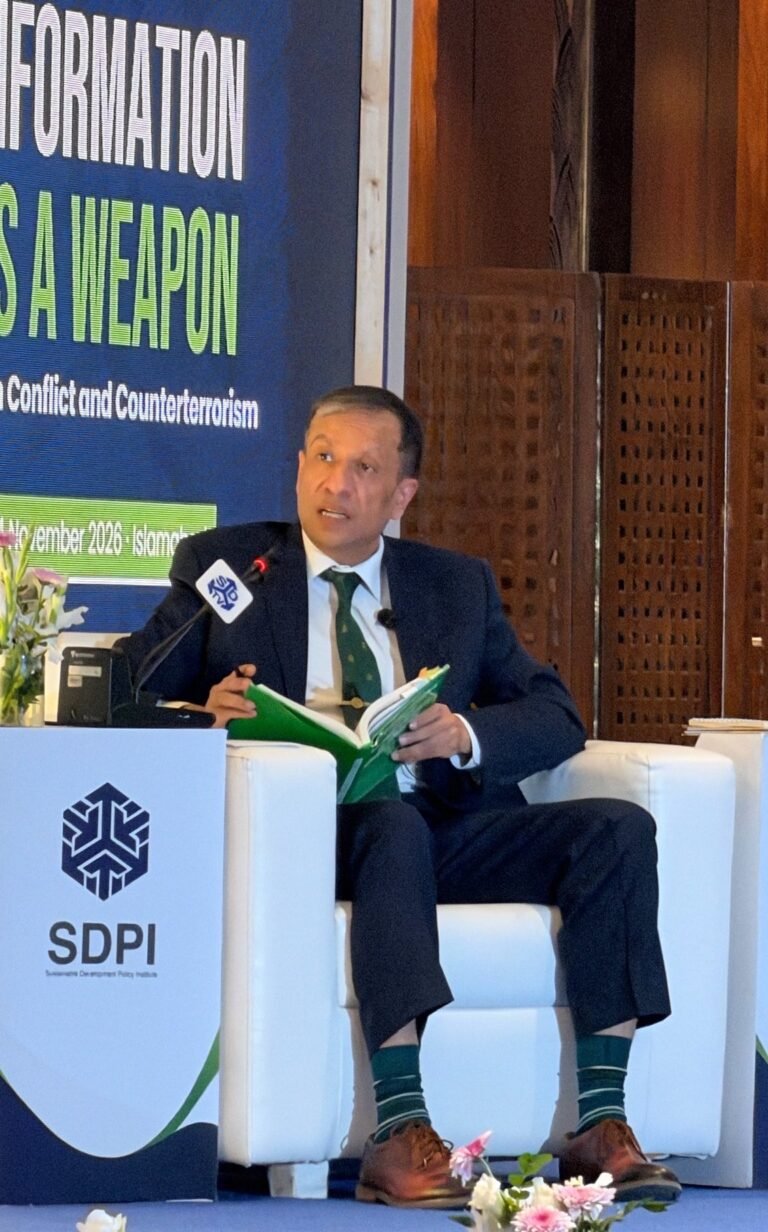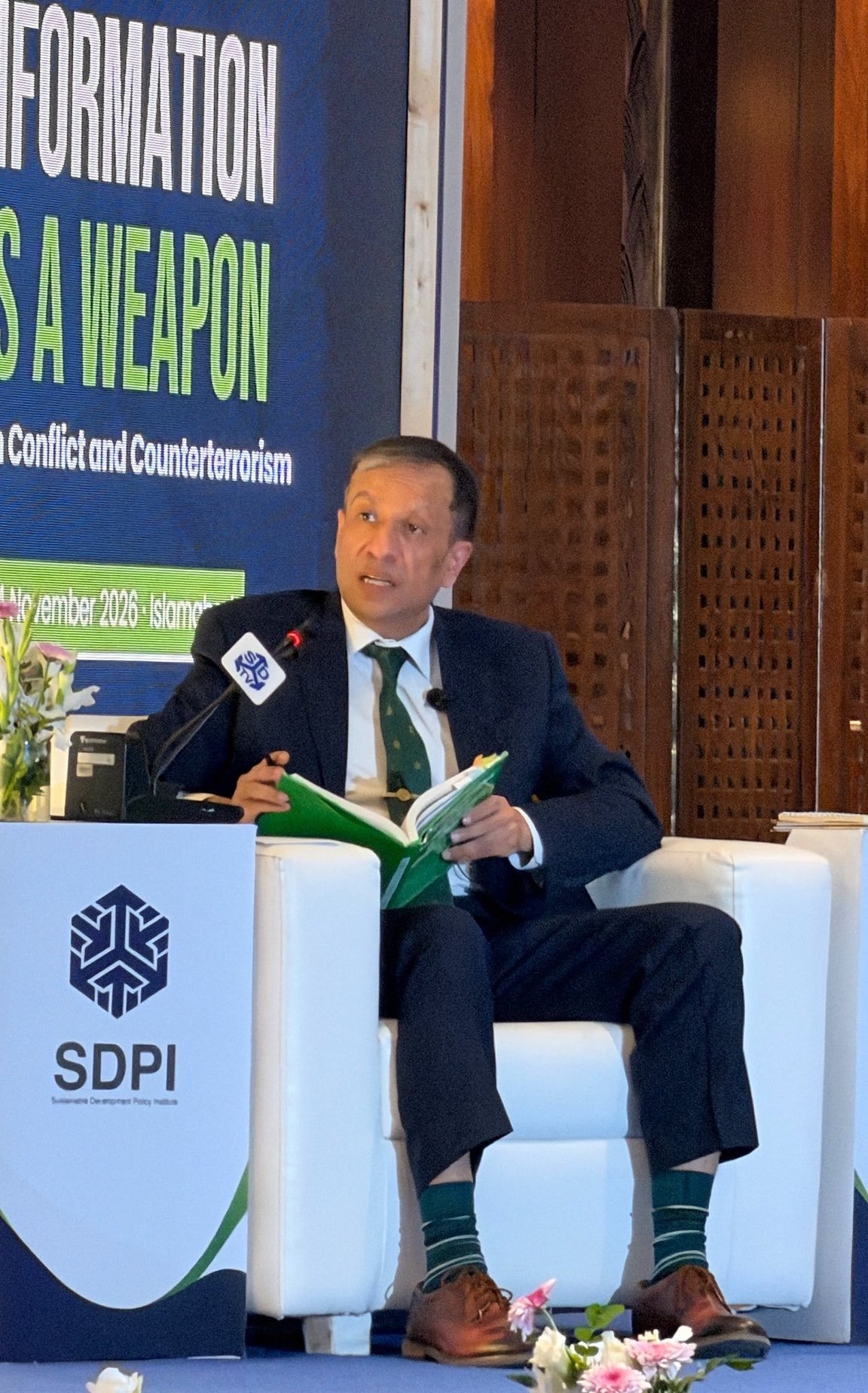
There was an important opportunity at the Sustainable Development Policy Institute’s international seminar on social media platforms and the post-truth era in Islamabad. A session titled Information as a Weapon: Modern Conflict and Counterterrorism brought together senior journalist Umar Cheema as moderator and Director General ISPR, Lieutenant General Ahmed Sharif Chaudhry, as the principal speaker.
The subject deserved a serious, structured and intellectually challenging discussion. Information warfare is no longer a peripheral aspect of modern conflict. It influences public perception, national security, diplomatic relations, political stability and even the outcome of international confrontations.
Yet, judging by the line of questioning in the discussion, the opportunity to explore this subject was not fully utilised.
The conversation, as I followed it, moved towards questions about how particular events were countered, why the Peshawar Corps Commander made certain remarks, the issue of minerals, and eventually the meaning of the establishment.
These may be legitimate questions in their own right. Some may even deserve detailed scrutiny. But what did they contribute to the central subject of the session?
That is where the problem lies.
The moderator’s responsibility was not simply to put questions to a senior military spokesperson. It was to keep the conversation anchored to its stated subject, build one question upon another, challenge the answers where necessary, and leave the audience with a deeper understanding of the subject than it had before.
The real questions were much bigger.
How does information become a strategic weapon in modern warfare? How do state and non-state actors manufacture narratives? What is the difference between legitimate strategic communication, propaganda and disinformation? How do artificial intelligence, algorithmic amplification, deepfakes and coordinated social media networks change the nature of conflict?
How does Pakistan distinguish between genuine criticism of state institutions and deliberately coordinated disinformation? What institutional mechanisms exist to identify and respond to information operations? Who verifies the information used to make such assessments? How can the state counter hostile narratives without undermining public trust, freedom of expression or its own credibility?
And perhaps most importantly, how does Pakistan develop a national information-resilience framework that is not dependent on responding to every controversy after it has already gained traction?
These are the questions that could have made the session genuinely valuable.
Instead, the discussion appears to have spent valuable time on individual incidents and political sensitivities without developing a coherent examination of the subject.
This is a recurring weakness in Pakistan’s journalistic culture. There is often an emphasis on asking a difficult or controversial question, but considerably less attention to constructing a discussion that produces knowledge.
A journalist can ask 20 questions and still fail to explain a single issue.
A productive interview, on the other hand, has an intellectual direction. It begins with a central question, establishes the context, examines the evidence, challenges assumptions, pursues inconsistencies and gradually takes the audience towards a more comprehensive understanding.
The objective is not to demonstrate how many controversial questions a journalist can put to a guest. It is to make the guest explain something the audience did not previously understand.
That requires preparation, subject knowledge and the discipline to resist the temptation of abandoning the topic whenever a controversial issue presents itself.
The subject of information warfare is particularly important for Pakistan. The country operates in a difficult regional and international information environment, where security developments, geopolitical competition, domestic political disagreements and digital platforms intersect.
Whether one agrees with the state’s assessment of a particular information operation or not, the public deserves a serious explanation of the evidence, the methods involved and the institutional response.
That is precisely why such discussions matter.
A journalist interviewing the DG ISPR has access to an opportunity to ask questions that ordinary citizens may not be able to put directly to the institution. But that opportunity carries a responsibility: to extract meaningful information, and seek clarity.
The audience should leave knowing more about information warfare, not simply knowing that another controversy has been discussed.
The problem is not a shortage of journalists, television anchors or controversial questions. Pakistan has plenty of all three.
The problem is whether our mainstream journalism is producing discussions that improve public understanding.
We need journalists who read beyond daily headlines, understand the subjects they moderate, prepare questions around a defined objective and have the intellectual discipline to pursue an argument to its logical conclusion.
If the subject is information as a weapon, discuss information as a weapon. If the subject is modern conflict, examine the changing architecture of modern conflict. If the subject is counterterrorism, investigate the strategies, institutions, evidence and consequences involved.
There is room for questions about minerals, political statements and the establishment. But a session’s title cannot become a decorative heading while its actual discussion travels elsewhere.
Journalism is not measured by the number of questions asked, the prominence of the person answering them, or the controversy generated in the room. It is measured by the quality of understanding it leaves behind.
And on a subject as consequential as information warfare, Pakistan deserved a discussion that did considerably more than ask what happened. It deserved one that explained how, why, by whom, and what comes next.
About the Author